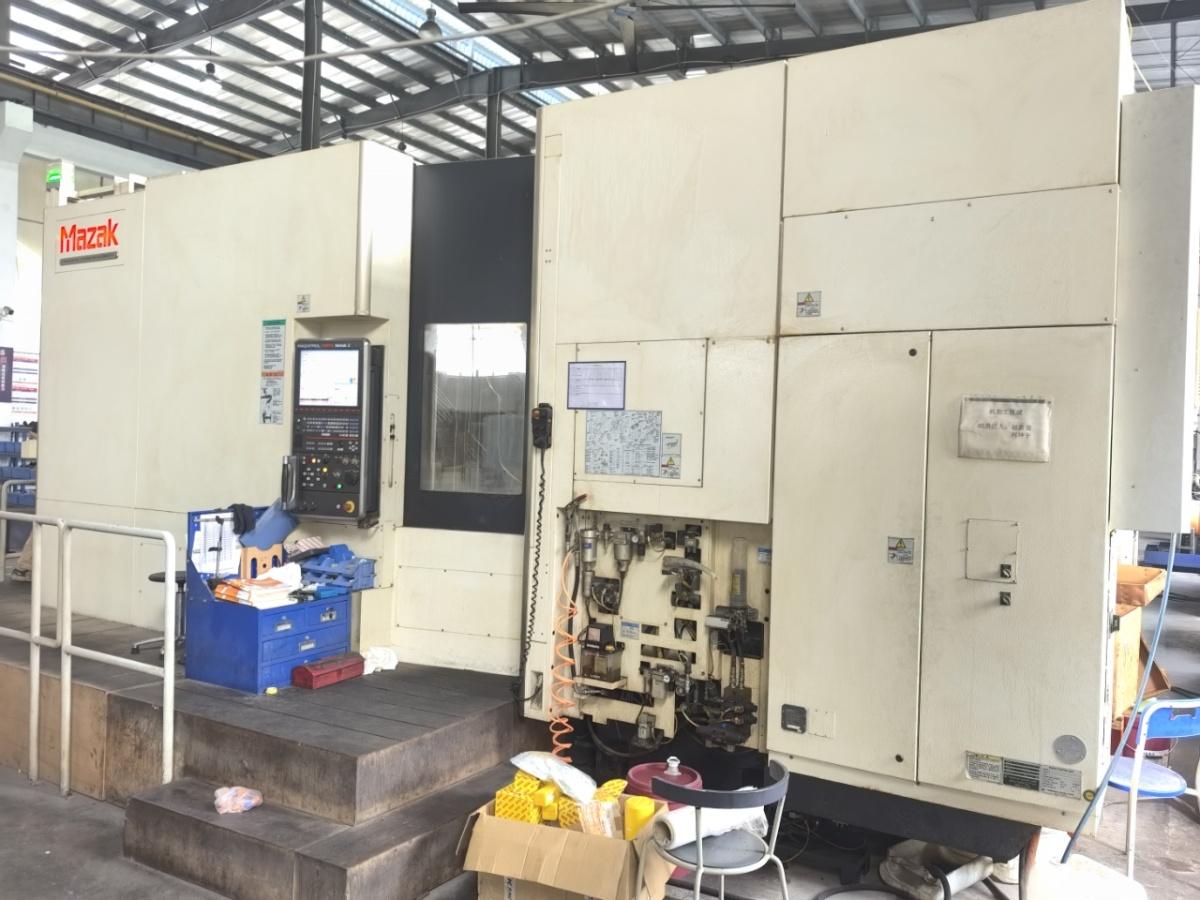
Used Mazak FF5000/40 L Horizontal Machining Center
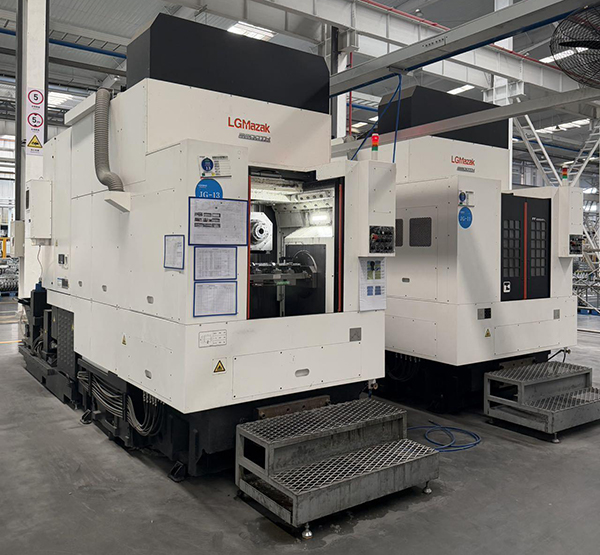 The Mazak FF5000/40 L is a high-performance horizontal machining center (HMC) engineered for high-speed, high-precision production environments. As a 2024 model, this machine integrates the Smooth C control system with a high-rigidity HSK-A63 spindle interface, offering a balance of speed and stability. With a 660 × 660 × 550 mm travel envelope and a 0.001° A-axis, this unit is designed to handle complex geometries and multi-face machining tasks efficiently. Currently in stock and available for immediate inspection, this machine is a versatile solution for manufacturers in the automotive, aerospace, medical device, and precision mold-making sectors looking to boost capacity with a proven, modern platform.
Core Specifications and What They Mean in Production
| Specification | Detail |
|---|---|
| Model | Mazak FF5000/40 L |
| CNC Control | SMOOTH C |
| Spindle Interface | HSK-A63 |
| Max Spindle Speed | 12,000 rpm |
| Travel (X, Y, Z) | 660 × 660 × 550 mm |
| Table Size | Ø500 mm |
| A-Axis Precision | 0.001° |
| Tool Magazine | 30 Tools |
| Max Table Load | 15 kg |
| Included Systems | Through-spindle coolant, Chip conveyor, Oil mist collector, Oil-water separation |
Understanding these specifications is vital for aligning the machine with your specific throughput requirements:
- Smooth C Control: This control system is designed to minimize non-cutting time. In production, this translates to faster block processing and more intuitive operation, which is critical for shops running high-mix, low-volume parts or complex, high-speed finishing paths.
- HSK-A63 Spindle Interface: Unlike traditional BT tapers, the HSK interface provides face-and-taper contact. This significantly improves rigidity and vibration damping at high RPMs, essential for maintaining surface finish quality on aluminum or difficult-to-machine alloys.
- 12,000 RPM Spindle: This speed range is optimized for high-speed machining (HSM). It allows for faster feed rates during finishing operations, effectively reducing cycle times for automotive and electronics components.
- 0.001° A-Axis: The high-resolution indexing allows for precise angular positioning. This is a requirement for complex parts that need machining on multiple faces without repositioning the workpiece, ensuring geometric accuracy across the entire part.
Tooling Match and Part Fit
The Mazak FF5000/40 L is built for versatility. The combination of the HSK-A63 spindle and the 30-tool magazine makes it an ideal candidate for production lines that require frequent tool changes or complex tool paths. The Ø500 mm table, combined with the 15 kg load capacity, suggests this machine is optimized for precision-oriented, lightweight components rather than heavy-duty, large-scale casting machining.
Suitable Industries and Applications:
- Automotive: Ideal for machining small-to-medium engine components, transmission parts, and sensor housings where high-speed finishing is required.
- Medical Devices: The precision of the A-axis and the stability of the HSK spindle make this suitable for complex surgical instrument components and medical implants.
- Electronics: Excellent for housing components and heat sinks that require high-speed milling and precise hole patterns.
- Mold Making: Capable of handling small-to-medium mold inserts and cavities where surface finish and dimensional accuracy are paramount.
How the Key Specs Affect Machine Selection
When selecting a horizontal machining center, the "fit" depends on your throughput requirements and part geometry. The FF5000/40 L is a specialized tool. The 660mm X/Y travel provides a generous working area for its class, allowing for multi-part fixturing on the 500mm table. If your production involves parts that fit within this envelope and require high-speed, high-precision finishing, this machine offers a significant advantage over standard vertical machining centers by providing 4-axis capabilities and efficient chip management.
The included chip conveyor and oil-mist collector are essential for high-volume production. They ensure that the machine can run for extended periods without operator intervention for cleaning or environmental maintenance, which is a key factor in calculating the true cost-per-part in a production cell.
Is This Machine Right for Your Production?
This machine is an excellent investment for factories that are:
- Scaling up production: If your current vertical machining centers are struggling with cycle times or requiring too many setups, the horizontal configuration of the FF5000/40 L can consolidate processes.
- Focusing on precision: For shops where tolerance requirements are becoming tighter, the HSK-A63 spindle and 0.001° indexing provide the necessary repeatability.
- Optimizing for speed: The 12,000 RPM spindle is designed for high-speed throughput. If your parts are made of aluminum or non-ferrous materials, this machine will likely outperform slower, gear-driven machines.
However, if your production involves heavy-duty roughing of large steel castings, the 15 kg load limit and the high-speed spindle design may not be the optimal match. Always evaluate your heaviest fixture and workpiece weight against the machine's load capacity before purchase.
Frequently Asked Questions
Q: Is the Mazak FF5000/40 L suitable for high-volume automotive parts?
A: Yes, it is highly suitable. The 12,000 RPM spindle, 30-tool magazine, and integrated chip management systems are designed to support high-speed, continuous production cycles typical in automotive component manufacturing.
Q: Can I use standard BT tooling with this machine?
A: No. This machine is equipped with an HSK-A63 spindle interface. HSK tooling provides superior rigidity and clamping force at high speeds compared to BT tapers, which is necessary for the performance capabilities of this model.
Q: What is the primary advantage of the Smooth C control for my operators?
A: The Smooth C control features a high-speed processor that reduces cycle times by accelerating data handling. It also offers a user-friendly interface that simplifies complex programming and setup, reducing the time required for part changeovers.
Q: How does the 0.001° A-axis benefit my production?
A: The 0.001° resolution allows for extremely precise angular positioning. This enables the machining of complex features on multiple faces of a part in a single setup, significantly increasing accuracy and reducing the need for additional fixtures or re-clamping.
Q: Is this machine ready for immediate shipment?
A: Yes, this unit is currently in stock. We recommend scheduling an inspection to verify the machine's condition and discuss your specific logistics requirements for transport and installation.
More Articles
-
Mazak CNC Machines: Popular Machine Types, Applications and Buying TipsChoosing among Mazak CNC Machines starts with your part geometry, required operations and setup strategy. Shafts and flanges generally suit turning centers; housings and plates suit machining centers. Parts combining turned diameters with milled features may justify a multitasking machine, provided its configuration and programming requirements match your work. Match the Mazak machine category to the job Mazak family names help narrow a shortlist, but capabilities vary by model, generation and installed options. QUICK TURN identifies a turning-center family, while INTEGREX covers multitasking machines. Confirm the individual machine’s specification before assuming it supports live tooling, a second spindle or simultaneous five-axis machining. Machine category Typical application Used-purchase check Turning center Automotive shafts, bushings and flanges Spindle condition, chuck operation, turret indexing and tailstock alignment where fitted Vertical machining center Plates, brackets, molds and housings Spindle taper, tool changes, axis motion and table condition Horizontal machining center Multi-face machining of prismatic components Pallet repeatability, indexing mechanism and chip evacuation Multitasking machine Components requiring turning and milling in fewer setups Milling spindle, rotary-axis accuracy and spindle transfer where equipped Check application fit beyond travel and chuck size For a used Mazak, verify usable working space with the intended chuck, fixtures, tools and workpiece installed. Nominal axis travel alone does not establish whether a deep housing or long shaft can be machined without interference. Match spindle speed and torque characteristics to the material and cutting process. Confirm tool capacity, coolant arrangements and chip handling against the planned cycle. A multitasking machine can reduce reclamping, but its value depends on tool access, programming capability and whether the combined operations balance effectively. Request evidence before committing to a used Mazak Identity and configuration: Obtain the nameplate, serial number, control version, option list and manuals. Check that the quotation matches the machine offered. Mechanical condition: Request a demonstration from cold, followed by operation at working temperature. Inspect lubrication, leaks, spindle noise, axis reversal and tool changes. Machining evidence: Specify a representative test cut and dimensional report. For demanding work, request appropriate geometry, positioning or rotary-axis test results. Control and ownership records: Review alarm and maintenance history, available backups, and installed MAZATROL or EIA/ISO programming functions. Verify software transfer conditions and service support for that machine. Buyer questions Can a Mazak turning center also mill parts? Some configurations provide live tooling and additional axes. Verify the installed hardware, travel and control options; a turning-center designation alone does not establish milling capability. Is a running video sufficient inspection evidence? A video can demonstrate basic operation, but cannot establish machining accuracy or thermal stability. Request dated test results tied to the machine’s serial number and agree acceptance criteria before purchase.
-
Vertical vs. Horizontal Machining Center: Key Differences and ApplicationsThe vertical vs horizontal machining center decision starts with the part: which faces need machining, how it can be clamped, and how often it will repeat. A vertical machining center (VMC) often suits plates, open pockets and varied small batches. A horizontal machining center (HMC) often suits prismatic housings requiring several side faces, particularly in repeat production. How spindle orientation changes the process A VMC has a vertical spindle above the table, providing direct access to upward-facing features. Side machining generally requires refixturing, a rotary attachment or an appropriate multi-axis configuration. An HMC has a horizontal spindle. Many configurations include an indexing rotary table, allowing several sides of a workpiece to face the spindle without unclamping. Tombstone fixtures can hold multiple parts, but tool clearance, fixture rigidity and the rotary working envelope determine usable access. Vertical vs horizontal machining center comparison Decision factor Vertical machining center Horizontal machining center Typical work Plates, dies, open cavities and top-face features Gearbox housings, valve bodies and multi-face prismatic parts Face access Direct top access; side features may require additional setups Rotary indexing often exposes several side faces in one clamping Chip evacuation Pockets can retain chips and require effective flushing Gravity helps chips fall from many cutting zones; pockets can still trap chips Production pattern Often practical for frequent changeovers and smaller batches Repeat batches can benefit from multiple-part fixtures and pallet exchange Investment considerations Often a lower entry investment for comparable basic work Rotary tables, pallets and fixtures can increase initial investment Match capacity and productivity to the actual part Workpiece size alone does not determine orientation. Check axis travel, table or pallet load, spindle reach and tool clearance with the fixture included. On an HMC, a tall or offset part must also clear the enclosure throughout table rotation. For a plate machined mainly from above, a VMC can provide a straightforward setup. For a housing with intersecting bores on several sides, an HMC may reduce reclamping and associated datum-transfer errors. Neither layout guarantees better accuracy; machine condition, thermal behavior, tooling and fixturing remain decisive. Compare total time per accepted part, including loading, indexing, chip clearing and inspection. Pallet exchange can overlap loading with cutting when fitted, but its value depends on cycle length, repeat demand and available fixtures. Questions before selecting a configuration Can a VMC machine several faces? Yes. Rotary equipment or a five-axis configuration can provide additional access. Confirm collision clearance, load capacity and whether indexing or simultaneous motion is required. Does an HMC always cut faster? No. Its advantage often comes from fewer setups and less idle time. Cutting rate still depends on spindle capability, rigidity, tooling and material. What should a used-machine buyer compare? Verify condition and installed options, especially rotary positioning, pallet operation and chip handling. Compare tooling, fixture and installation costs against the intended production schedule.
-
Can Third-Party Machine Inspection Be Arranged Before Shipment?When purchasing used industrial CNC machine tools from international suppliers, one of the most frequently asked questions from factory buyers and machinery traders is whether third-party machine inspection is allowed before shipment. For high-value equipment such as horizontal machining centers, verifying machine accuracy, operating condition, and original configuration is essential to avoid purchasing risks. The clear and official answer is yes. We fully support complete third-party on-site inspection and pre-shipment testing for our in-stock 2015 Japan original MAZAK HCN8800-II Horizontal Machining Centre (Inventory No. 68596). Buyers can arrange their own engineers or internationally recognized inspection institutions to conduct full machine verification before delivery. Why Pre-Shipment Inspection Is Important for Used HMC Machines Horizontal machining centers are core industrial equipment used for high-precision mass production. Unlike ordinary mechanical equipment, CNC HMC machines require stable spindle performance, precise axis positioning, and consistent repeat accuracy during long-term processing. For cross-border second-hand machine transactions, information asymmetry is the biggest concern for buyers. Through professional third-party inspection, customers can confirm the machine’s manufacturing year, original configuration, running status, machining accuracy, and overall mechanical condition on-site. This inspection process greatly reduces purchasing risks and ensures the machine fully meets factory production standards after arrival. Supported Inspection Items for MAZAK HCN8800-II To ensure full transparency of machine condition, we allow all-round unrestricted inspection for the stocked MAZAK HCN8800-II. All inspection work can be carried out under power-on running status. Inspectors can check the complete machine configuration, including the original MAZATROL MATRIX NEXUS2 CNC system, system version, operating hours, and electronic control status. Meanwhile, full stroke testing of the X, Y, and Z axes, fast movement testing, and precision calibration are permitted. Spindle rotation accuracy, tool magazine operation, pallet switching function, and hydraulic system status can also be fully verified. In addition, inspectors are allowed to take photos, record running videos, measure geometric accuracy, and check the overall appearance and structural integrity of the machine. Full Specifications of Stocked 2015 MAZAK HCN8800-II This available Mazak horizontal machining center is a Japan-made 2015 model with complete original factory configurations, suitable for heavy-duty and high-precision industrial processing. The machine adopts a three-axis travel of 1400mm × 1200mm × 1325mm, providing a large machining range for medium and large workpieces. It is equipped with dual 800mm × 800mm worktables, supporting automatic pallet exchange to achieve uninterrupted batch production. The maximum worktable load reaches 2200KG, which meets heavy cutting requirements for steel, cast iron, and alloy workpieces. The spindle distance from the worktable ranges from 100mm to 1275mm, with a maximum machining diameter and height of 1450mm. The worktable indexing resolution is as accurate as 0.001 degrees, ensuring ultra-precise multi-angle positioning. Equipped with a high-performance BT50 spindle, the maximum spindle speed reaches 10,000 rpm, balancing high cutting efficiency and smooth surface machining quality. The machine is fitted with a 60-station automatic tool magazine, supporting automatic tool change. The maximum tool length is 800mm, and the maximum tool weight is 30KG, adapting to various complex machining processes. The X, Y, and Z axes adopt a high-speed moving design, with a fast feed rate of 60,000 mm/min for all three axes, effectively improving overall production efficiency. Inspection Rules and Shipment Arrangement For international orders, the third-party inspection process is arranged after preliminary order confirmation. The machine will be kept in complete standby status for testing. The inspection date can be freely confirmed according to the buyer’s schedule. Generally, the inspection fee and travel expense of the third-party organization are borne by the buyer. After the inspection is completed and the machine condition is confirmed qualified, we will arrange professional disassembly, packaging, and international shipping procedures. Suitable Industries for MAZAK HCN8800-II This Mazak HCN8800-II horizontal machining center is widely applicable for aerospace parts, automotive components, mold processing, engineering machinery parts, and precision mechanical parts manufacturing. With high rigidity, stable precision, and high automation, it is an ideal device for enterprises that need large-scale continuous multi-surface machining. Final Conclusion Transparent pre-shipment inspection is the most effective guarantee for cross-border used CNC machine purchases. We sincerely support full third-party inspection for our stocked 2015 Japanese MAZAK HCN8800-II Horizontal Machining Centre. Every customer can confirm the real machine condition on-site before shipment, ensuring safe, reliable, and risk-free equipment procurement.
-
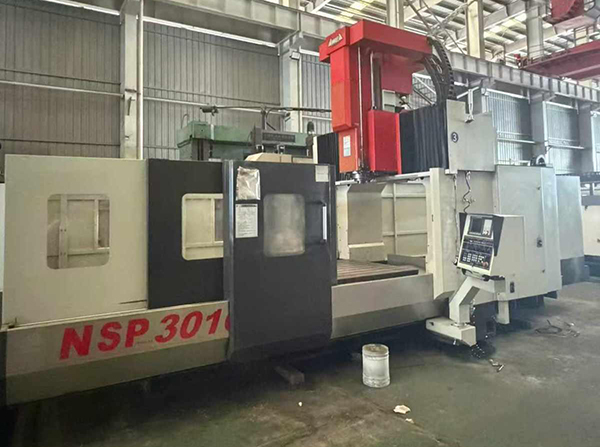
Can I arrange a third-party inspection before shipment for AWEA NSP3016 Gantry Machining Centre?Overview of AWEA NSP3016 Gantry Machining Centre The AWEA NSP3016 Gantry Machining Centre is a high-performance, heavy-duty CNC gantry milling machine originating from Taiwan, China. Manufactured in 2018, this reliable second-hand gantry machine has stable mechanical structure, high machining precision and super heavy load capacity, widely used in mold processing, mechanical equipment manufacturing, automotive parts, hardware processing and large industrial workpiece production. For international buyers who care about machine quality, arranging a professional third-party inspection before shipment is fully acceptable and supported. We provide complete inspection conditions, open machine test cutting, precision detection and full condition verification to guarantee the machine meets industrial standard requirements. Basic Machine Information & Inventory Details This AWEA NSP3016 gantry machining centre is available in stock with complete and clear machine information for customer verification. The detailed machine profile is as follows: • Inventory Number: 812669 • Brand: AWEA • Model: NSP3016 • Origin: Taiwan, China • Manufacturing Year: 2018 All machine data is true and consistent with the physical machine. No modification, no hidden faults and no overhaul records. The whole machine maintains original factory structure and stable running performance, suitable for long-term factory continuous production. Main Technical Specifications and Processing Capacity The AWEA NSP3016 gantry machining centre owns large processing travel and super heavy bearing capacity, which can meet most large-scale and heavy-duty processing demands. Three-axis travel reaches 3060 × 1600 × 760 mm, providing ultra-large processing space for large molds and oversized workpieces. The worktable size is 3000 × 1500 mm, with a maximum load capacity up to 10,000 kg, supporting heavy workpiece clamping and cutting. The gantry width is 1700 mm and gantry height is 1200 mm, ensuring rigid gantry structure, strong stability and no vibration during high-precision cutting. Equipped with a standard 24-position tool magazine, the machine realizes automatic tool changing, reduces manual operation time and greatly improves production efficiency. It can complete batch processing of multi-process workpieces efficiently. Professional Configuration and Processing Advantages This AWEA NSP3016 gantry machining centre is equipped with a practical side milling head configuration, which greatly enriches the machine’s processing functions. Except for conventional plane milling, drilling and tapping, it can complete side milling, inclined surface processing and multi-angle complex workpiece forming processing. One-time clamping can realize multi-surface processing, effectively improving workpiece precision consistency and reducing secondary clamping errors. With rigid gantry body design, high-precision guide rail and stable spindle system, the machine features small cutting error, smooth workpiece surface and stable long-term working accuracy. It is very suitable for high-standard processing requirements of mold factories and precision machinery enterprises. Pre-shipment Third-Party Inspection Support We fully support customers to arrange third-party inspection before shipment for the AWEA NSP3016 gantry machining centre. During the inspection period, we can provide power-on test run, actual cutting test, precision parameter detection, mechanical structure inspection and electrical system checking. All machine parameters, appearance performance and working conditions can be fully verified by the customer’s designated inspection institution. We adhere to transparent machine condition, honest trading and full cooperation with pre-shipment inspection, ensuring every imported machine is in good working condition for overseas buyers.