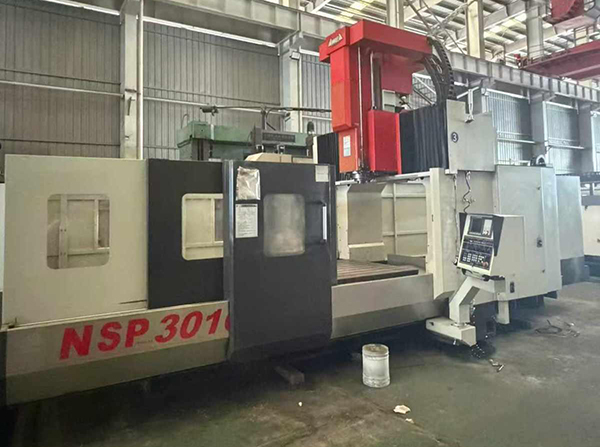
Used Hartford CNC-5210H Machining Center: Specifications and Capacity
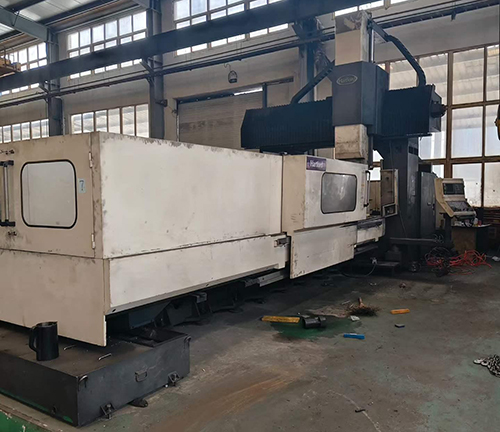 The Hartford CNC-5210H is a heavy-duty bridge-type machining center engineered for large-scale workpieces. Featuring a 5000mm X-axis travel and a 10,000kg table load capacity, this machine is built for structural components, large mold bases, and long-bed machining. Currently in stock and available for inspection, this unit is equipped with a Fanuc 21i-MR control and a BT50 spindle—an ideal solution for shops requiring high-rigidity milling and an expansive work envelope. This page outlines the technical specifications to help you determine if this machine aligns with your production requirements.
Core Specifications and Production Capabilities
The Hartford CNC-5210H’s specifications define its operational limits and production capabilities. Review the key technical data below.
| Model | Hartford CNC-5210H |
|---|---|
| Stock Number | 67445 |
| X/Y/Z Travel | 5000 x 2100 x 1000 mm |
| Table Dimensions | 5150 x 2040 mm |
| Table Load Capacity | 10,000 kg |
| Spindle Taper | BT50 |
| Spindle Speed | 6000 rpm |
| Tool Changer | 32 Tools |
| Control System | Fanuc 21i-MR |
| Door Width | 2300 mm |
Travel and Table Capacity
The 5000mm X-axis travel is the machine's defining feature, enabling the machining of long-span parts—such as automotive chassis dies, aerospace spars, or large machine bases—in a single setup. The 10,000kg load capacity ensures the table remains stable under the weight of heavy fixtures and raw materials.
Spindle and Tooling
The BT50 spindle taper is the industry standard for heavy-duty milling. Unlike BT40 spindles, which are optimized for high-speed aluminum finishing, the BT50 delivers the torque required for deep cuts in steel and cast iron. With a 6000 rpm limit, this machine is balanced for high-torque roughing and semi-finishing applications.
Industry Applications and Part Fit
The Hartford CNC-5210H is a versatile workhorse for factories handling diverse, large-part portfolios. Its configuration is particularly well-suited for the following industries:
- Automotive: Ideal for large stamping dies and heavy-duty fixture plates.
- Aerospace: Suitable for long structural frames and wing-rib components where precision and rigidity are paramount.
- Mold Making: The bridge structure provides the stability required for deep-cavity mold machining.
- Energy & Infrastructure: Capable of handling large housings, valve bodies, and gear casings.
The 32-tool magazine supports complex, multi-process setups, allowing the machine to handle a wide range of tooling—from large-diameter face mills to drills and taps—without frequent manual changes. This is essential for shops managing mixed-batch production or complex parts requiring multiple operations.
Evaluating Machine Selection
When evaluating this machine for your production, consider how its physical footprint aligns with your throughput goals:
- Single-Setup Efficiency: If you are currently moving large parts between multiple machines, the 5000mm travel of the CNC-5210H may allow you to consolidate operations, reducing handling time and improving dimensional accuracy.
- Rigidity vs. Speed: This machine is built for rigidity. If your production involves light aluminum parts requiring 15,000+ rpm, this machine may be overpowered. However, for heavy material removal in steel, the BT50 spindle is the optimal choice.
- Control Familiarity: The Fanuc 21i-MR is a widely recognized industrial control. It offers high reliability and broad compatibility with modern CAD/CAM software, minimizing the learning curve for operators and programmers.
Is This Machine Right for Your Production?
This machine is a significant asset for shops looking to scale up capacity for large-format parts. It is an ideal fit if:
- You have a recurring need to machine parts exceeding 3 meters in length.
- Your current bottleneck is a lack of table space or weight capacity.
- You require a machine capable of heavy-duty roughing cycles without vibration.
- You need a reliable, industry-standard controller that integrates easily with your existing workflow.
If your production consists primarily of small, high-volume parts, this machine may be oversized, leading to inefficient floor space utilization. Evaluate your largest current part and your projected growth over the next 3–5 years to determine if this envelope is appropriate.
Inspection and Verification
Before finalizing the procurement of this used Hartford CNC-5210H, we recommend performing the following checks to verify the machine's condition:
- Spindle Runout: Inspect the BT50 spindle taper for signs of galling or excessive wear. Perform a runout test with a test bar to ensure precision is within tolerance.
- Way Cover Integrity: Inspect the telescopic way covers for damage or leaks. Given the machine's long travel, these covers are critical for protecting the axes from chips and coolant.
- Axis Repeatability: Run a warm-up cycle and use a dial indicator to check repeatability on the X and Y axes. Ensure there is no significant backlash in the ballscrews.
- Control Functionality: Power on the Fanuc 21i-MR, check for alarm history, and cycle the 32-tool magazine to ensure smooth operation and correct tool indexing.
Frequently Asked Questions
Q: Is the 5000mm travel the total working area for all axes?
A: The 5000mm refers to the X-axis (longitudinal) travel. The Y-axis provides 2100mm of cross travel, and the Z-axis provides 1000mm of vertical travel, providing a substantial working envelope for large, long components.
Q: Can this machine handle high-speed aluminum machining?
A: The machine is optimized for heavy-duty cutting with a BT50 spindle and 6000 rpm. While it can machine aluminum, it is not a dedicated high-speed machine; it excels in applications requiring high torque and structural rigidity.
Q: Is the Fanuc 21i-MR control compatible with modern software?
A: Yes, the Fanuc 21i-MR is a robust industry-standard control that supports standard G-code programming and is compatible with most modern CAD/CAM post-processors.
Q: What is the benefit of the 2300mm door width?
A: The wide door opening is designed to accommodate large, bulky workpieces that require overhead crane loading. It facilitates easier setup and safer loading/unloading of heavy parts.
More Articles
-
Mazak CNC Machines: Popular Machine Types, Applications and Buying TipsChoosing among Mazak CNC Machines starts with your part geometry, required operations and setup strategy. Shafts and flanges generally suit turning centers; housings and plates suit machining centers. Parts combining turned diameters with milled features may justify a multitasking machine, provided its configuration and programming requirements match your work. Match the Mazak machine category to the job Mazak family names help narrow a shortlist, but capabilities vary by model, generation and installed options. QUICK TURN identifies a turning-center family, while INTEGREX covers multitasking machines. Confirm the individual machine’s specification before assuming it supports live tooling, a second spindle or simultaneous five-axis machining. Machine category Typical application Used-purchase check Turning center Automotive shafts, bushings and flanges Spindle condition, chuck operation, turret indexing and tailstock alignment where fitted Vertical machining center Plates, brackets, molds and housings Spindle taper, tool changes, axis motion and table condition Horizontal machining center Multi-face machining of prismatic components Pallet repeatability, indexing mechanism and chip evacuation Multitasking machine Components requiring turning and milling in fewer setups Milling spindle, rotary-axis accuracy and spindle transfer where equipped Check application fit beyond travel and chuck size For a used Mazak, verify usable working space with the intended chuck, fixtures, tools and workpiece installed. Nominal axis travel alone does not establish whether a deep housing or long shaft can be machined without interference. Match spindle speed and torque characteristics to the material and cutting process. Confirm tool capacity, coolant arrangements and chip handling against the planned cycle. A multitasking machine can reduce reclamping, but its value depends on tool access, programming capability and whether the combined operations balance effectively. Request evidence before committing to a used Mazak Identity and configuration: Obtain the nameplate, serial number, control version, option list and manuals. Check that the quotation matches the machine offered. Mechanical condition: Request a demonstration from cold, followed by operation at working temperature. Inspect lubrication, leaks, spindle noise, axis reversal and tool changes. Machining evidence: Specify a representative test cut and dimensional report. For demanding work, request appropriate geometry, positioning or rotary-axis test results. Control and ownership records: Review alarm and maintenance history, available backups, and installed MAZATROL or EIA/ISO programming functions. Verify software transfer conditions and service support for that machine. Buyer questions Can a Mazak turning center also mill parts? Some configurations provide live tooling and additional axes. Verify the installed hardware, travel and control options; a turning-center designation alone does not establish milling capability. Is a running video sufficient inspection evidence? A video can demonstrate basic operation, but cannot establish machining accuracy or thermal stability. Request dated test results tied to the machine’s serial number and agree acceptance criteria before purchase.
-
Vertical vs. Horizontal Machining Center: Key Differences and ApplicationsThe vertical vs horizontal machining center decision starts with the part: which faces need machining, how it can be clamped, and how often it will repeat. A vertical machining center (VMC) often suits plates, open pockets and varied small batches. A horizontal machining center (HMC) often suits prismatic housings requiring several side faces, particularly in repeat production. How spindle orientation changes the process A VMC has a vertical spindle above the table, providing direct access to upward-facing features. Side machining generally requires refixturing, a rotary attachment or an appropriate multi-axis configuration. An HMC has a horizontal spindle. Many configurations include an indexing rotary table, allowing several sides of a workpiece to face the spindle without unclamping. Tombstone fixtures can hold multiple parts, but tool clearance, fixture rigidity and the rotary working envelope determine usable access. Vertical vs horizontal machining center comparison Decision factor Vertical machining center Horizontal machining center Typical work Plates, dies, open cavities and top-face features Gearbox housings, valve bodies and multi-face prismatic parts Face access Direct top access; side features may require additional setups Rotary indexing often exposes several side faces in one clamping Chip evacuation Pockets can retain chips and require effective flushing Gravity helps chips fall from many cutting zones; pockets can still trap chips Production pattern Often practical for frequent changeovers and smaller batches Repeat batches can benefit from multiple-part fixtures and pallet exchange Investment considerations Often a lower entry investment for comparable basic work Rotary tables, pallets and fixtures can increase initial investment Match capacity and productivity to the actual part Workpiece size alone does not determine orientation. Check axis travel, table or pallet load, spindle reach and tool clearance with the fixture included. On an HMC, a tall or offset part must also clear the enclosure throughout table rotation. For a plate machined mainly from above, a VMC can provide a straightforward setup. For a housing with intersecting bores on several sides, an HMC may reduce reclamping and associated datum-transfer errors. Neither layout guarantees better accuracy; machine condition, thermal behavior, tooling and fixturing remain decisive. Compare total time per accepted part, including loading, indexing, chip clearing and inspection. Pallet exchange can overlap loading with cutting when fitted, but its value depends on cycle length, repeat demand and available fixtures. Questions before selecting a configuration Can a VMC machine several faces? Yes. Rotary equipment or a five-axis configuration can provide additional access. Confirm collision clearance, load capacity and whether indexing or simultaneous motion is required. Does an HMC always cut faster? No. Its advantage often comes from fewer setups and less idle time. Cutting rate still depends on spindle capability, rigidity, tooling and material. What should a used-machine buyer compare? Verify condition and installed options, especially rotary positioning, pallet operation and chip handling. Compare tooling, fixture and installation costs against the intended production schedule.
-
Can Third-Party Machine Inspection Be Arranged Before Shipment?When purchasing used industrial CNC machine tools from international suppliers, one of the most frequently asked questions from factory buyers and machinery traders is whether third-party machine inspection is allowed before shipment. For high-value equipment such as horizontal machining centers, verifying machine accuracy, operating condition, and original configuration is essential to avoid purchasing risks. The clear and official answer is yes. We fully support complete third-party on-site inspection and pre-shipment testing for our in-stock 2015 Japan original MAZAK HCN8800-II Horizontal Machining Centre (Inventory No. 68596). Buyers can arrange their own engineers or internationally recognized inspection institutions to conduct full machine verification before delivery. Why Pre-Shipment Inspection Is Important for Used HMC Machines Horizontal machining centers are core industrial equipment used for high-precision mass production. Unlike ordinary mechanical equipment, CNC HMC machines require stable spindle performance, precise axis positioning, and consistent repeat accuracy during long-term processing. For cross-border second-hand machine transactions, information asymmetry is the biggest concern for buyers. Through professional third-party inspection, customers can confirm the machine’s manufacturing year, original configuration, running status, machining accuracy, and overall mechanical condition on-site. This inspection process greatly reduces purchasing risks and ensures the machine fully meets factory production standards after arrival. Supported Inspection Items for MAZAK HCN8800-II To ensure full transparency of machine condition, we allow all-round unrestricted inspection for the stocked MAZAK HCN8800-II. All inspection work can be carried out under power-on running status. Inspectors can check the complete machine configuration, including the original MAZATROL MATRIX NEXUS2 CNC system, system version, operating hours, and electronic control status. Meanwhile, full stroke testing of the X, Y, and Z axes, fast movement testing, and precision calibration are permitted. Spindle rotation accuracy, tool magazine operation, pallet switching function, and hydraulic system status can also be fully verified. In addition, inspectors are allowed to take photos, record running videos, measure geometric accuracy, and check the overall appearance and structural integrity of the machine. Full Specifications of Stocked 2015 MAZAK HCN8800-II This available Mazak horizontal machining center is a Japan-made 2015 model with complete original factory configurations, suitable for heavy-duty and high-precision industrial processing. The machine adopts a three-axis travel of 1400mm × 1200mm × 1325mm, providing a large machining range for medium and large workpieces. It is equipped with dual 800mm × 800mm worktables, supporting automatic pallet exchange to achieve uninterrupted batch production. The maximum worktable load reaches 2200KG, which meets heavy cutting requirements for steel, cast iron, and alloy workpieces. The spindle distance from the worktable ranges from 100mm to 1275mm, with a maximum machining diameter and height of 1450mm. The worktable indexing resolution is as accurate as 0.001 degrees, ensuring ultra-precise multi-angle positioning. Equipped with a high-performance BT50 spindle, the maximum spindle speed reaches 10,000 rpm, balancing high cutting efficiency and smooth surface machining quality. The machine is fitted with a 60-station automatic tool magazine, supporting automatic tool change. The maximum tool length is 800mm, and the maximum tool weight is 30KG, adapting to various complex machining processes. The X, Y, and Z axes adopt a high-speed moving design, with a fast feed rate of 60,000 mm/min for all three axes, effectively improving overall production efficiency. Inspection Rules and Shipment Arrangement For international orders, the third-party inspection process is arranged after preliminary order confirmation. The machine will be kept in complete standby status for testing. The inspection date can be freely confirmed according to the buyer’s schedule. Generally, the inspection fee and travel expense of the third-party organization are borne by the buyer. After the inspection is completed and the machine condition is confirmed qualified, we will arrange professional disassembly, packaging, and international shipping procedures. Suitable Industries for MAZAK HCN8800-II This Mazak HCN8800-II horizontal machining center is widely applicable for aerospace parts, automotive components, mold processing, engineering machinery parts, and precision mechanical parts manufacturing. With high rigidity, stable precision, and high automation, it is an ideal device for enterprises that need large-scale continuous multi-surface machining. Final Conclusion Transparent pre-shipment inspection is the most effective guarantee for cross-border used CNC machine purchases. We sincerely support full third-party inspection for our stocked 2015 Japanese MAZAK HCN8800-II Horizontal Machining Centre. Every customer can confirm the real machine condition on-site before shipment, ensuring safe, reliable, and risk-free equipment procurement.
-
Can I arrange a third-party inspection before shipment for AWEA NSP3016 Gantry Machining Centre?Overview of AWEA NSP3016 Gantry Machining Centre The AWEA NSP3016 Gantry Machining Centre is a high-performance, heavy-duty CNC gantry milling machine originating from Taiwan, China. Manufactured in 2018, this reliable second-hand gantry machine has stable mechanical structure, high machining precision and super heavy load capacity, widely used in mold processing, mechanical equipment manufacturing, automotive parts, hardware processing and large industrial workpiece production. For international buyers who care about machine quality, arranging a professional third-party inspection before shipment is fully acceptable and supported. We provide complete inspection conditions, open machine test cutting, precision detection and full condition verification to guarantee the machine meets industrial standard requirements. Basic Machine Information & Inventory Details This AWEA NSP3016 gantry machining centre is available in stock with complete and clear machine information for customer verification. The detailed machine profile is as follows: • Inventory Number: 812669 • Brand: AWEA • Model: NSP3016 • Origin: Taiwan, China • Manufacturing Year: 2018 All machine data is true and consistent with the physical machine. No modification, no hidden faults and no overhaul records. The whole machine maintains original factory structure and stable running performance, suitable for long-term factory continuous production. Main Technical Specifications and Processing Capacity The AWEA NSP3016 gantry machining centre owns large processing travel and super heavy bearing capacity, which can meet most large-scale and heavy-duty processing demands. Three-axis travel reaches 3060 × 1600 × 760 mm, providing ultra-large processing space for large molds and oversized workpieces. The worktable size is 3000 × 1500 mm, with a maximum load capacity up to 10,000 kg, supporting heavy workpiece clamping and cutting. The gantry width is 1700 mm and gantry height is 1200 mm, ensuring rigid gantry structure, strong stability and no vibration during high-precision cutting. Equipped with a standard 24-position tool magazine, the machine realizes automatic tool changing, reduces manual operation time and greatly improves production efficiency. It can complete batch processing of multi-process workpieces efficiently. Professional Configuration and Processing Advantages This AWEA NSP3016 gantry machining centre is equipped with a practical side milling head configuration, which greatly enriches the machine’s processing functions. Except for conventional plane milling, drilling and tapping, it can complete side milling, inclined surface processing and multi-angle complex workpiece forming processing. One-time clamping can realize multi-surface processing, effectively improving workpiece precision consistency and reducing secondary clamping errors. With rigid gantry body design, high-precision guide rail and stable spindle system, the machine features small cutting error, smooth workpiece surface and stable long-term working accuracy. It is very suitable for high-standard processing requirements of mold factories and precision machinery enterprises. Pre-shipment Third-Party Inspection Support We fully support customers to arrange third-party inspection before shipment for the AWEA NSP3016 gantry machining centre. During the inspection period, we can provide power-on test run, actual cutting test, precision parameter detection, mechanical structure inspection and electrical system checking. All machine parameters, appearance performance and working conditions can be fully verified by the customer’s designated inspection institution. We adhere to transparent machine condition, honest trading and full cooperation with pre-shipment inspection, ensuring every imported machine is in good working condition for overseas buyers.